

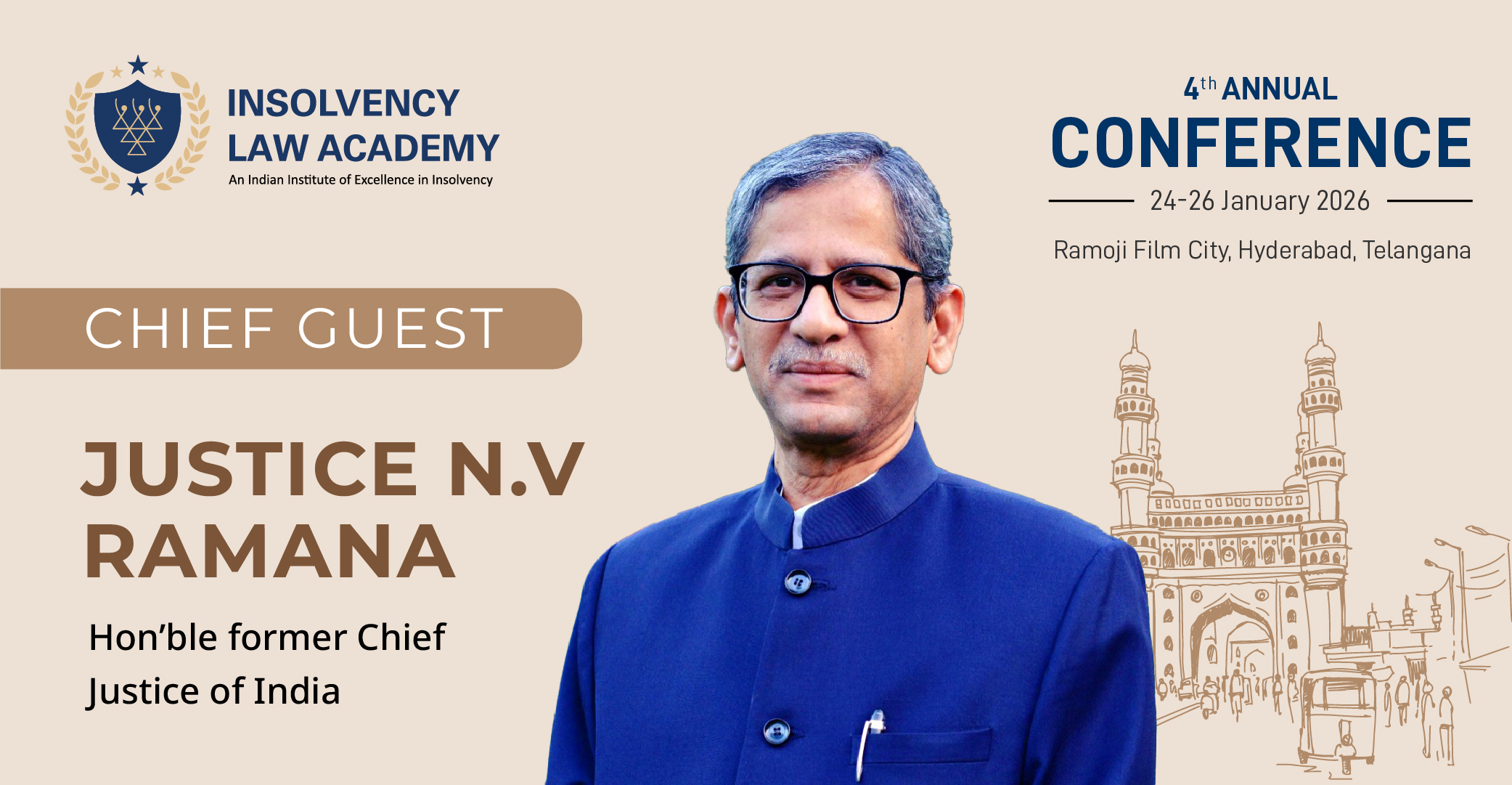
Address by the Chief Guest at the ILA’s 4th Annual Conference
Justice N.V. Ramana, Former Chief Justice of India, Supreme Court of India*
It is a matter of great pleasure for me to be with you this evening at the 4th Annual Conference of the Insolvency Law Academy.
I must thank Mr. Sumant Batra for extending his warm invitation to me. Alongside his work as a leading insolvency lawyer, author and policy expert, he is also a cinema enthusiast. It is therefore a remarkable coincidence that we are gathered at Ramoji Film City—a landmark institution and a defining milestone in India’s cinematic journey.
I congratulate the Insolvency Law Academy for creating an institution that has become an intellectual hub for insolvency law and policy, in a remarkably short span of time.
The organisers have thoughtfully curated this conference to reflect upon the growing dimensions of insolvency law. I applaud them for bringing together experts from across the globe for a meaningful deliberation.
I welcome all the delegates to Hyderabad. I hope you get a chance to explore this wonderful city and its hospitality.
We have all read about the scene in Shakespeare’s Merchant of Venice, where a moneylender stands before a judge, and demands what the law promised him—a pound of flesh for an unpaid debt. The contract was clear and there was an admitted debt. And yet, enforcing the contract did not feel just. That moment captures the essence of insolvency law in its earliest and most honest form. Insolvency was not seen as an economic consequence, but a social, moral, and deeply human situation.
Over time, as economies became more complex, insolvency law also became more elaborate, structured, and focused. What initially began as a question of moral obligation transformed into a framework for economic continuity, orderly distribution, and collective resolution.
Yet, the underlying question remained unchanged: How does a society treat those who fail?
Modern insolvency law recognises that failure is not always the result of moral wrongdoing, but also of risk, uncertainty, and economic cycles. We are living through a period of profound economic uncertainty. Recent years have shown that tariff impositions, changes in supply-chain, war, political regime changes, climate change, and energy shocks can unsettle global markets far beyond their geographic origin. These developments are symptoms of the changing world order.
Economic decisions are being made based on strategic considerations rather than commercial logic. In such an environment, financial markets have become highly sensitive. Many enterprises today operate on thin margins, debt-driven financing, and globally integrated supply chains. Any sharp correction in markets can destabilise viable businesses.
The truth is, in an interconnected world, insolvency is not an anomaly. It is a risk assumed within the global economic architecture itself.
During the Covid-19 pandemic, a virus originated in one country, but affected the entire world, including people in distant rural India, who had no connection with the outside world. Similarly, excessive tariffs imposed by the President of the US affect shrimp farmers in India. The undeniable fact is—in an increasingly globalised world, even the common man faces the music of far-away global events. This reality has compelled us to rethink our understanding of insolvency. Modern insolvency law seeks not flesh, but resolution. Not retribution, but renewal. Therefore, the insolvency frameworks must be responsive, adaptive, and sensitive to these shocks.
Businesses in India have consistently flagged concerns relating to over governance, regulatory multiplicity, excessive compliance, and procedural delays. Over the past decade, attempts have been made at addressing these. At the same time, the Indian judiciary’s approach has remained anchored on the fundamental principle of upholding the rule of law. The judiciary has balanced efficiency with constitutional promises. Due process is an essential feature of our legal system, which cannot be discarded for the sake of speedy conclusion.
We must remember that investor confidence is sustained not merely by speed or flexibility, but by fairness, consistency, and institutional credibility, which are possible only if due process is followed.
In this background, in 2016, India adopted the Insolvency and Bankruptcy Code (IBC) to provide for effective resolution of financially distressed businesses. It was a decisive shift in economic governance. Broadly, the results have shown that IBC has led to genuine value discovery through competitive market processes.
According to the latest quarterly reports published by the IBBI, during the financial year 2023–24, 269 resolution plans were approved—the highest number since the inception of the Code.
Nearly 40% of companies resolved under the IBC were either defunct or earlier stuck before BIFR. These cases have led to recoveries of around 155% of the liquidation value. 308 corporate debtors were rescued through early settlements, withdrawals, and negotiated exits, showing positive impact of IBC on debtor behaviour.
An independent study by IIM Ahmedabad examined firms post-IBC resolution and found significant improvements in profitability, liquidity, turnover, and operational efficiency. There have been significant gains for banks as well. For decades, Indian banks were weighed down by mounting non-performing assets and prolonged recovery processes.
The absence of a credible exit mechanism meant that stress accumulated silently on balance sheets, thereby impairing the ability of banks. The IBC has improved credit discipline through strict timelines. It puts the creditors in control, which is a strong deterrent for borrowers. The IBC has helped banks to clean up their balance sheets in a structured and transparent manner. At a macroeconomic level, the IBC reinforced confidence—in banks, in markets, and in businesses. To ensure that the goals of the IBC are fulfilled, we must keep evaluating and reassessing the working of the Code. The last 10 years have seen numerous amendments, judgments, and discussion papers.
The IBC is still struggling to provide speedy and time-bound resolution of corporate debtors. The ground reality is that the 330-day timeline for concluding CIRP is being stretched to 600–700 days. The time for admitting insolvency applications has stretched to several months instead of 14 days.
The answer is simple but bitter—legislative provisions alone cannot remedy delay. Legislative timelines can sometimes become unrealistic. The time period for resolving a company with a turnover of Rs 10 crores cannot be the same for a company that has a turnover of Rs 10,000 crores. We must recognise that our economic landscape is shaped not only by large corporations and institutional creditors, but by micro and small enterprises, informal workers, and others. Institutional capacity has not expanded proportionately, with nearly 7000 IBC cases pending across various NCLT benches.
The Government needs to address infrastructural problems on a war footing basis. The qualification, training, and service conditions of NCLT and NCLAT members require urgent attention. It is also unfortunate to see insolvency adjudication being burdened by interlocutory applications and the trappings of civil suits. The lack of clarity on the law also delays insolvency resolution. Every passing day diminishes asset value, jeopardises employment, discourages resolution applicants, and undermines creditor confidence. Environmental liability is also an emerging trigger of insolvency.
Lastly, we must recognise that the judiciary plays a crucial role in the success of insolvency law. Insolvency law is a process-driven economic legislation whose effectiveness depends on certainty, timelines, and predictability.
Strengthening insolvency tribunals is a prerequisite for preserving the rule of law in economic governance. I commend the Insolvency Law Academy for fostering these conversations and contributing to the evolution of insolvency law in India.
I wish the Conference every success.
Thank you. Namaskar.
*Address by the Chief Guest at the 4th Annual Conference on Saturday, 24th January, 2026, held at Ramoji Film City, Hyderabad
Recent Posts
Judicial Reversals of Approved IBC Resolution Plans in India

Speech by the Guest of Honour at the 4th Annual Conference